Over the course of the previous year, we have made significant strides in identifying statistical trends. We have gathered Creyos assessment results for a considerable number of clients. These assessments, conducted at regular intervals of approximately three months, serve as a benchmark to gauge our clients’ progress against their past results and peers in their age group. Individual results are a crucial part of each client’s coach-feedback session. We have now reached a stage where we can analyze aggregate group results, providing an overview of certain aspects of our program’s impact.
Our brain and body fitness model is firmly rooted in offering programs that are backed by rigorous scientific research. Decades of studies have established a substantial positive correlation between physical activity and brain health. For adults, our focus is on memory and executive function (executive function refers to the mental processes that enable us to plan, focus, solve problems, and control impulses), which tend to decline with age and deteriorate even more significantly with cognitive disease. Therefore, our primary concern is whether the subtests related to memory and executive function have shown improvement for clients who have committed to our comprehensive lifestyle program.
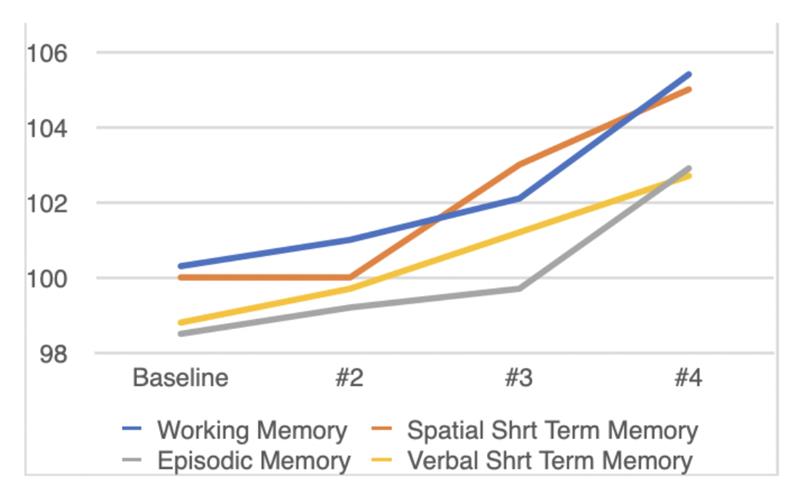
At this point, we see positive trends in four distinct types of memory for the clients who have participated at Activate for about one year. The graph below shows the results of our analysis, comparing initial scores across four assessments. Creyos scores are standardized, meaning that each client is compared to a database containing approximately 1000 people their age and gender, with a score of 100 in each subtest as the norm for that group. The advantage of standard scores is that we can compare different ages and different subtests using the same scale. The age range for this group of 69 clients was 26 to 88, with an average age of 64.
For the four memory scores on the graph, the group average started near the average score of 100 and trended upward over one year. While the number change is moderate, it’s important to remember that we don’t expect large changes. In fact, research suggests a slight decline in memory for this average age of 64. However, our program is designed to help maintain ‘normal’ memory as we age, and the evidence supports this. This is a testament to the positive impact that our program is having on our clients’ memory and cognitive function. We look forward to sharing more of our data as we continue to gather it in the coming months.